
Why Your Small Decorative Fixture May Need a Beam G9 Instead of a GU10
Author:Admin Publish time: September 18, 2026 Origin: Site
When you need directional light but don’t have room for a conventional spotlight lamp.
Designing a small decorative fixture often creates a difficult trade-off.
You want the fixture to remain compact, elegant and visually lightweight.
But you also want the light to go somewhere specific — onto a table, wall, artwork or reading surface.
A GU10 is an obvious choice when directional light is required. Its optical system is designed to control the beam effectively.
But sometimes there is a problem:
The fixture simply doesn’t have enough space for a GU10.
A conventional G9 solves the size problem, but creates another one: most G9 lamps distribute light widely rather than directing it toward a target.
This creates a gap between the two:
GU10 — good beam control, larger lamp format
Conventional G9 — miniature format, wide light distribution
For some compact decorative fixtures, a Beam G9 LED can offer another option.
Miniature size. Controlled light.
The Problem Is Often Fixture Size — Not the Light Requirement
Imagine designing a slim pendant or compact wall light.
The desired lighting effect is clear: the fixture should direct light downward or toward a defined surface.
A GU10 could create that effect.
But incorporating a GU10 also means accommodating its physical dimensions, lampholder and optical space.
Suddenly, the light source begins to influence the proportions of the entire fixture.
For decorative lighting designers, this matters.
The luminaire may need to become:
- wider
- deeper
- visually heavier
- or structurally different
just to accommodate the light source.
Sometimes that is perfectly acceptable.
Sometimes it compromises the original design.
This leads to a useful question:
Should the fixture be designed around the lamp — or should the lamp fit the fixture concept?
Why a Conventional G9 Doesn't Always Solve the Problem
Switching from GU10 to G9 immediately gives the designer more freedom because the G9 format is much smaller.
But conventional G9 LEDs are generally designed for broad light distribution.
Inside a directional pendant or wall light, this can mean that some of the light goes:
sideways
into the fixture body
toward the shade
or simply away from the intended target.
The lamp may still produce enough total lumens.
But those lumens are not necessarily being used efficiently by the fixture.
This is the same principle we discussed when comparing wide-distribution and Beam G9 LEDs:
Useful light can matter more than total light.
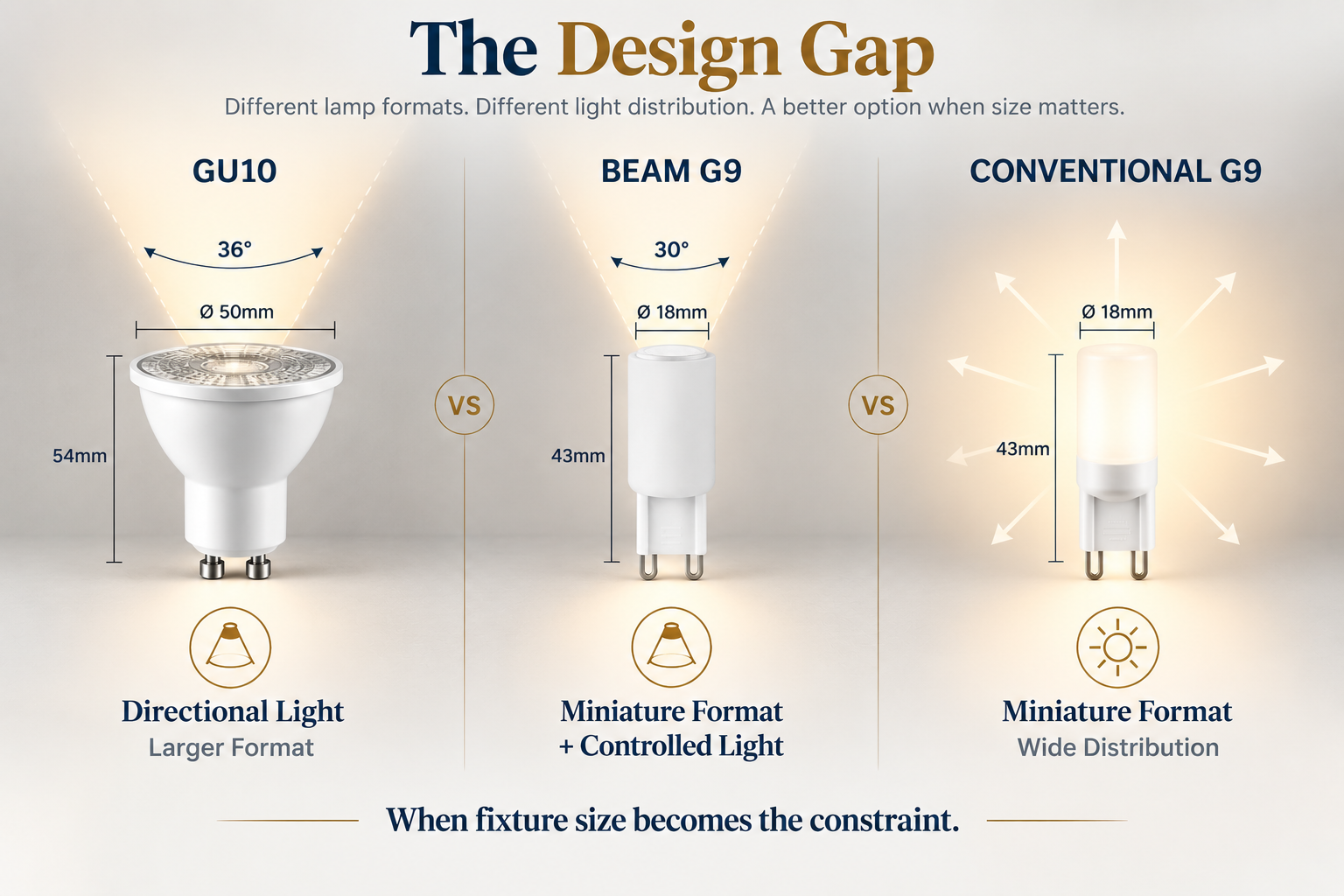
Where Beam G9 Creates Another Option
A Beam G9 combines the compact G9 form factor with controlled optical distribution.
Instead of sending light broadly in multiple directions, different optics can concentrate more light toward the intended area.
For example:
15° — Focus
A concentrated beam for small target areas or stronger accent effects.
30° — Balance
Directional light with more practical coverage.
60° — Wider Control
A broader pool of light while maintaining directional distribution.
This gives designers another variable to work with:
Fixture Size + Beam Angle + Target Distance + Desired Effect
rather than simply choosing a lamp based on wattage and lumens.
Beam G9 Is Not a Smaller GU10
This distinction is important.
A Beam G9 should not be treated as a universal miniature replacement for GU10.
GU10 is a mature directional lamp platform with larger optical space and a wide range of lumen outputs and beam-control possibilities.
A miniature G9 has much less space available for:
LEDs · Driver Electronics · Thermal Management · Optics
That creates different engineering limitations.
So the question should not be:
“Can Beam G9 replace GU10?”
A better question is:
“Does this fixture actually need the size and performance of a GU10?”
If the application requires high output, sophisticated optics or strong long-distance beam performance, GU10 may still be the appropriate platform.
But if the application requires moderate output, compact dimensions and controlled light, Beam G9 becomes interesting.
Which Fixtures Could Benefit?
The strongest opportunities are fixtures where physical size and light direction matter at the same time.
Small Pendant Lights
A slim pendant may need to illuminate the table below without using a large spotlight lamp that changes the fixture proportions.
Compact Wall Lights
The designer may want controlled light toward a wall, artwork or reading area while keeping the luminaire visually minimal.
Reading Lights
A small decorative reading fixture needs useful task light, not simply light distributed throughout the shade.
Mini Spots
Some decorative fixtures need a spotlight-like effect but have insufficient space for GU10 or MR16.
Hospitality Lighting
Bedside lights, decorative pendants and compact feature lights can sometimes benefit from a smaller directional source where visual proportions are important.
In all of these applications, the key question is:
Can we achieve the required lighting effect without making the fixture larger?
Same Small Lamp. Different Beam. Different Fixture Experience.
Once light becomes directional, beam angle also influences how the fixture feels.
A 15° Beam G9 can create a concentrated, dramatic effect.
A 30° Beam G9 can provide a balance between focus and practical coverage.
A 60° Beam G9 can create a softer and broader illuminated area.
But beam angle should never be selected from the specification sheet alone.
The final result also depends on mounting distance.
A 30° beam positioned close to a table creates a smaller light pool than the same 30° beam positioned farther away.
That is why the development sequence should be:
Fixture → Target → Distance → Required Effect → Beam Angle
not:
Choose 30° → Design the fixture around it