
Why Color Consistency Matters More Than High CRI in Multi-Lamp Fixtures
Author:Admin Publish time: August 17, 2026 Origin: Site
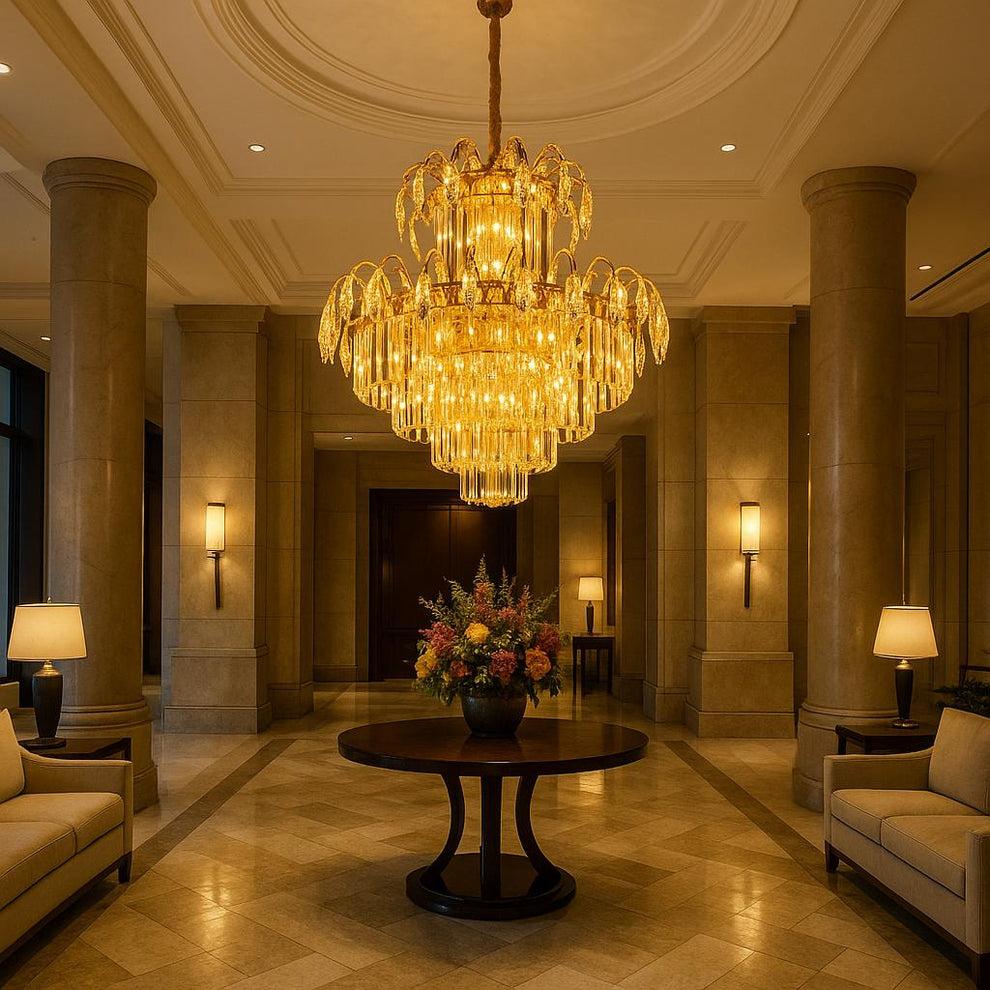
A chandelier can use CRI 95 LEDs and still look wrong. The problem may not be color rendering — it may be that the lamps do not match each other.
When lighting brands develop premium chandeliers, pendants or decorative fixtures, high CRI is often one of the first specifications discussed.
CRI 90. CRI 95. High R9.
These are important. But in a fixture using 10, 20 or even 50 G4 or G9 LED lamps, another factor can become even more visible:
color consistency between individual lamps.
One lamp slightly warmer. Another slightly cooler. One appears more yellow. Another slightly green or pink.
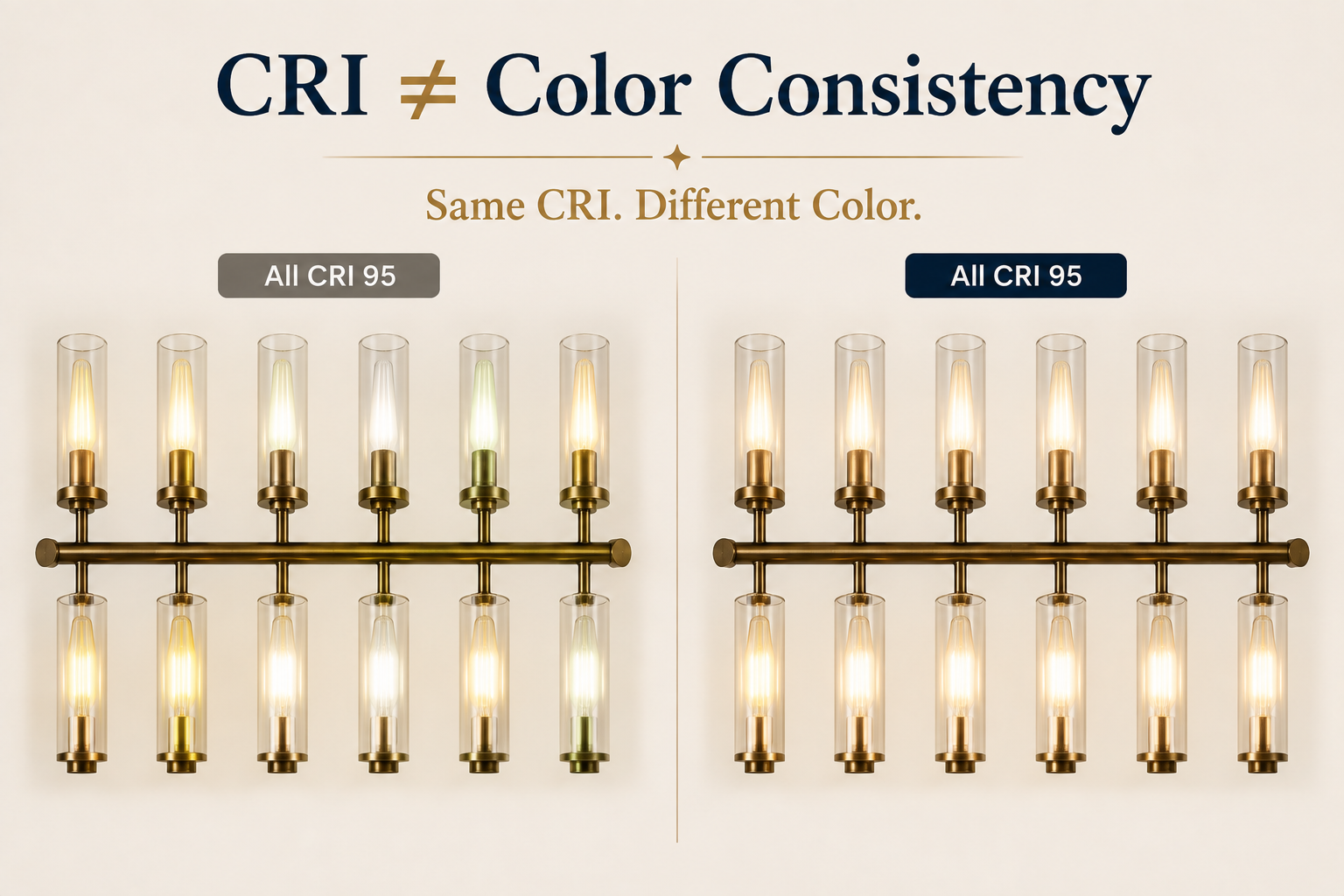
Individually, every lamp may meet the CRI requirement.
Installed together, however, the differences become obvious.
In a multi-lamp fixture, customers do not see the specification of one lamp. They see whether all the lamps look the same.
That is why premium decorative lighting requires more than high CRI. It requires a reliable method for verifying color consistency at unit level.
High CRI and Color Consistency Are Not the Same Thing
This distinction is important.
CRI describes how accurately a light source renders colors compared with a reference source.
Color consistency asks a different question:
How closely does Lamp A match Lamp B, Lamp C and every other lamp in the fixture?
You can therefore have:
Lamp A: CRI 95
Lamp B: CRI 95
Lamp C: CRI 95
and still have visible differences between them if their chromaticity coordinates, CCT or DUV vary.
This is particularly noticeable in decorative fixtures because multiple light sources are often visible simultaneously.
Why Multi-Lamp Fixtures Expose Color Differences
Imagine a decorative chandelier containing 24 G9 LEDs.
If you look at one lamp by itself, a small color deviation may be difficult to notice.
Place 24 lamps next to each other and the situation changes.
The human eye is very good at making side-by-side comparisons.
Small differences become easier to see when:
- lamps are close together
- the light sources are directly visible
- clear or transparent glass is used
- the fixture operates at low light levels
- warm CCTs are used
- the surrounding interior has neutral surfaces
This is why a lamp that looks perfectly acceptable in an integrating sphere can still create an unsatisfactory visual result when installed in a chandelier.
For premium lighting brands, this becomes more than a technical issue.
It becomes part of the perceived quality of the entire fixture.
SDCM Helps — But the Specification Alone Is Not Enough
Lighting professionals often use SDCM (Standard Deviation Colour Matching) or MacAdam ellipse terminology to describe color consistency.
In simple terms:
lower SDCM = tighter color consistency.
For example, an SDCM ≤3 specification represents tighter color control than SDCM ≤5.
But there is an important procurement question that often gets overlooked:
How does the supplier verify that the lamps actually shipped meet the required color consistency?
A specification sheet saying:
SDCM ≤3
does not, by itself, prove that every lamp in a shipment falls within that target.
An LED supplier may qualify the LED bin, inspect samples from production, or test a limited number of finished lamps.
Those methods can provide useful process control.
But for a premium multi-lamp application, sampling is fundamentally different from checking every finished lamp.
And this is where the verification method becomes critical.
The Most Important Question: How Is Color Consistency Actually Verified?
Suppose a production lot contains 5,000 G9 LEDs.
A supplier tests 20 samples.
All 20 look good.
Does that prove that the other 4,980 lamps have the same color characteristics?
No.
Sampling tells you something about the production lot.
It does not tell you the measured color performance of every individual lamp.
For a single-lamp application, that distinction may not always matter.
For a chandelier using dozens of lamps side by side, it can matter significantly.
That is why FRI's approach to premium color consistency focuses on something more direct:
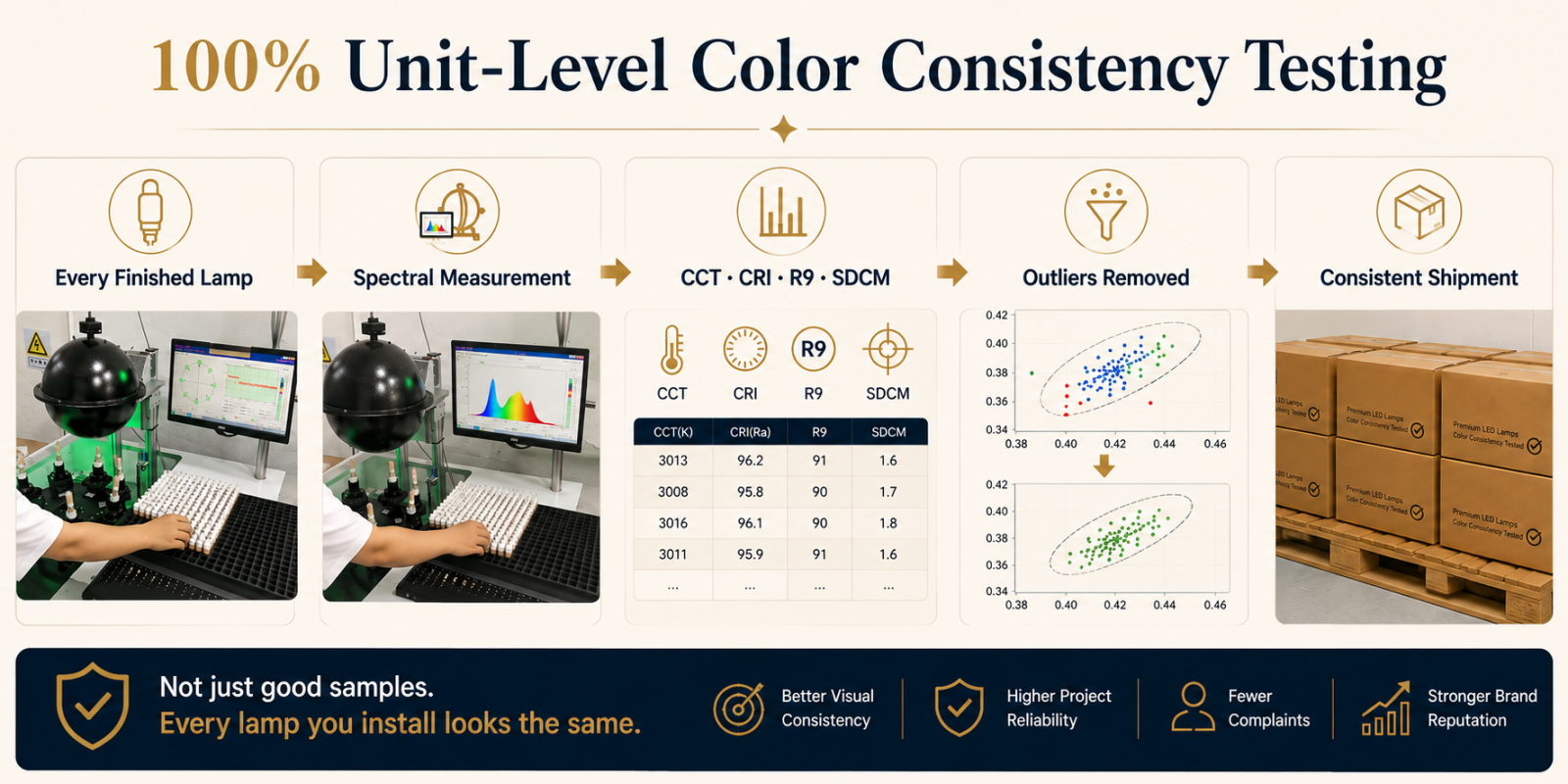
100% Unit-Level Color Consistency Testing
Rather than relying only on LED bin information or random finished-product sampling, FRI can perform spectral testing at the finished-lamp level for every unit on applicable premium production programs.
In other words:
1 lamp → 1 measurement
100 lamps → 100 measurements
1,000 lamps → 1,000 measurements
The objective is simple:
verify the finished lamp — not just the LED component or a small sample from the production lot.
What Do We Measure on Every Lamp?
Depending on the product and agreed production specification, finished-lamp spectral testing can record parameters such as:
CCT
Correlated Color Temperature
Chromaticity Coordinates (x, y)
The actual measured color position
CRI / Ra
General color rendering performance
R9
Saturated red rendering
SDCM / Color Deviation
Consistency relative to the defined target
Other spectral parameters can also be evaluated where required by the project.
The important distinction is that these measurements are taken from the finished lamp.
That matters because the final optical result is influenced not only by the LED package but potentially also by:
LED selection + operating current + thermal conditions + optical materials + driver behaviour + production variation.
So component-level binning is useful.
But ultimately, the customer installs the finished lamp, not the LED chip.
The Better Verification Process: Measure → Compare → Remove Outliers
This is the part lighting brands should pay particular attention to.
100% testing is useful only if the data is actually used to control production.
A practical premium-color workflow is:
1. Define the target before production
Agree the important requirements, for example:
CCT target
CRI minimum
R9 minimum
acceptable color-consistency range
For projects requiring tighter consistency, the limits should be defined before mass production rather than after the lamps arrive.
2. Measure every finished lamp
Each lamp is tested spectrally after production.
This generates actual finished-product data instead of relying only on nominal LED specifications.
3. Compare each unit against the agreed window
The measured values are checked against the production criteria.
The question is no longer:
“Is the production lot probably OK?”
It becomes:
“Is this individual lamp inside the agreed range?”
4. Identify and remove outliers
Units outside the agreed criteria can be separated before shipment.
This is particularly important because a few visually different lamps can compromise the appearance of an otherwise premium chandelier.
5. Maintain production-lot traceability
For demanding projects, measurement records can also help connect production performance with the relevant batch.
This creates a much stronger quality-control system than simply writing “CRI95 / SDCM≤3” on a specification sheet.
Specification defines the target. Unit-level testing verifies whether production actually achieved it.
Why This Matters Even More for G4 and G9 LEDs
Miniature G4 and G9 LEDs are widely used in decorative lighting because their compact dimensions allow designers to create smaller optical structures and more delicate luminaires.
But the same applications can make color inconsistency particularly visible.
Consider:
Crystal Chandeliers
Many lamps appear simultaneously through transparent or reflective materials.
Multi-Globe Pendants
Several illuminated glass globes may be directly within the viewer's field of vision.
Luxury Hotel Fixtures
Repeated luminaires across guestrooms, corridors and public areas make consistency important not only within one fixture but potentially across a project.
Restaurants
Warm materials, food and skin tones make both color rendering and color appearance important.
In these applications, the goal should not simply be:
“Every lamp is CRI95.”
It should be:
“Every lamp delivers the intended color quality — and they look consistent together.”
CRI95 + R9 + SDCM + DUV: Think of Color Quality as a System
This also explains why FRI's Premium Color approach should not be reduced to one number.
For demanding decorative lighting, several parameters work together.
| Parameter | What It Helps Control |
|---|---|
| CRI / Ra | Overall color rendering |
| R9 | Rendering of saturated reds |
| CCT | General warm/cool appearance |
| SDCM | Color consistency around a target |
| DUV | Tint relative to the black-body locus |
| Unit-Level Testing | Whether actual production lamps meet the target |
A lamp can have excellent CRI but poor consistency.
A lamp can have tight CCT but an undesirable tint.
And an impressive laboratory sample does not automatically guarantee that thousands of production lamps will behave identically.
That is why the last row — verification — is arguably the most important production step.
What Should Lighting Brands Ask Their LED Supplier?
When evaluating G4 or G9 LEDs for a multi-lamp fixture, do not ask only:
“What is the CRI?”
Ask:
What is your finished-lamp SDCM target?
What CCT tolerance do you control?
Do you monitor chromaticity or DUV?
Is testing performed on LED components or finished lamps?
Is production checked by sampling or 100% inspection?
What happens to units outside the agreed range?
Can production measurements be traced to the shipment?
These questions reveal much more about a supplier's actual color-control capability than a CRI number alone.
The Difference Between a Good Sample and a Consistent Shipment
This may be the most important lesson for premium lighting brands.
Getting five beautiful samples is relatively easy.
The real manufacturing challenge is producing:
5,000 lamps that remain within the agreed performance window.
That is why sample approval and mass-production control should be treated as two different stages.
FRI's 100% unit-level spectral testing is designed to close that gap.
For applicable premium G4/G9 programs, every finished lamp can be measured against agreed color criteria so that outliers can be identified before shipment.
This gives the buyer something much more useful than a promise of “good color consistency.”
It provides a verification method.
Premium color is not what one golden sample achieves.
Premium color is what the production lot can repeatedly deliver.
FAQ
Is CRI95 enough for a premium chandelier?
Not necessarily. CRI95 indicates strong color-rendering performance, but it does not guarantee that multiple lamps will have identical color appearance. Multi-lamp fixtures also need good CCT, chromaticity and color consistency control.
What does SDCM mean for LED lighting?
SDCM describes color variation around a target chromaticity point. Lower SDCM generally means tighter color matching between lamps.
Why can two CRI95 G9 LEDs look different?
They can have similar CRI while differing in CCT, chromaticity or DUV. CRI and color consistency measure different characteristics.
How should G9 LED color consistency be verified?
For demanding multi-lamp applications, finished-lamp spectral measurement provides stronger verification than relying only on LED bin information. Testing every finished lamp provides unit-level evidence of production consistency.
Does FRI test every G4 or G9 LED?
For applicable premium production programs, FRI can perform 100% finished-lamp spectral testing according to the agreed project requirements. The exact testing and acceptance criteria should be defined for each product and order.
Why is 100% testing useful for chandeliers?
Because even a small number of visibly different lamps can stand out when many sources are viewed side by side. Unit-level testing allows outliers to be identified before shipment.
Developing a Multi-Lamp Fixture?
If your chandelier, pendant or decorative luminaire uses multiple G4 or G9 LEDs, send us:
lamp quantity per fixture + CCT + CRI/R9 requirement + target SDCM + dimming requirement
We can evaluate not only whether the lamp meets the target specification, but also how that consistency can be verified during mass production.
Ask for Unit-Level Color Consistency Data →
Because for a premium multi-lamp fixture:
High CRI defines the color quality of the lamp.
Consistency defines the visual quality of the fixture.
100% testing verifies that production actually delivers it.