The Biggest Challenge in Designing a Miniature G4 or G9 LED Lamp
Author:Admin Publish time: August 19, 2026 Origin: Site
Making an LED lamp smaller is easy. Making it small, bright, dimmable, reliable and consistent at the same time is not.
A G4 or G9 LED lamp may be one of the smallest components inside a decorative luminaire.
But from an engineering perspective, miniature LED lamps can be surprisingly difficult to design well.
Lighting brands often begin a new project with a specification that sounds straightforward:
Smaller size. More lumens. Higher CRI. Better dimming. Longer lifetime.
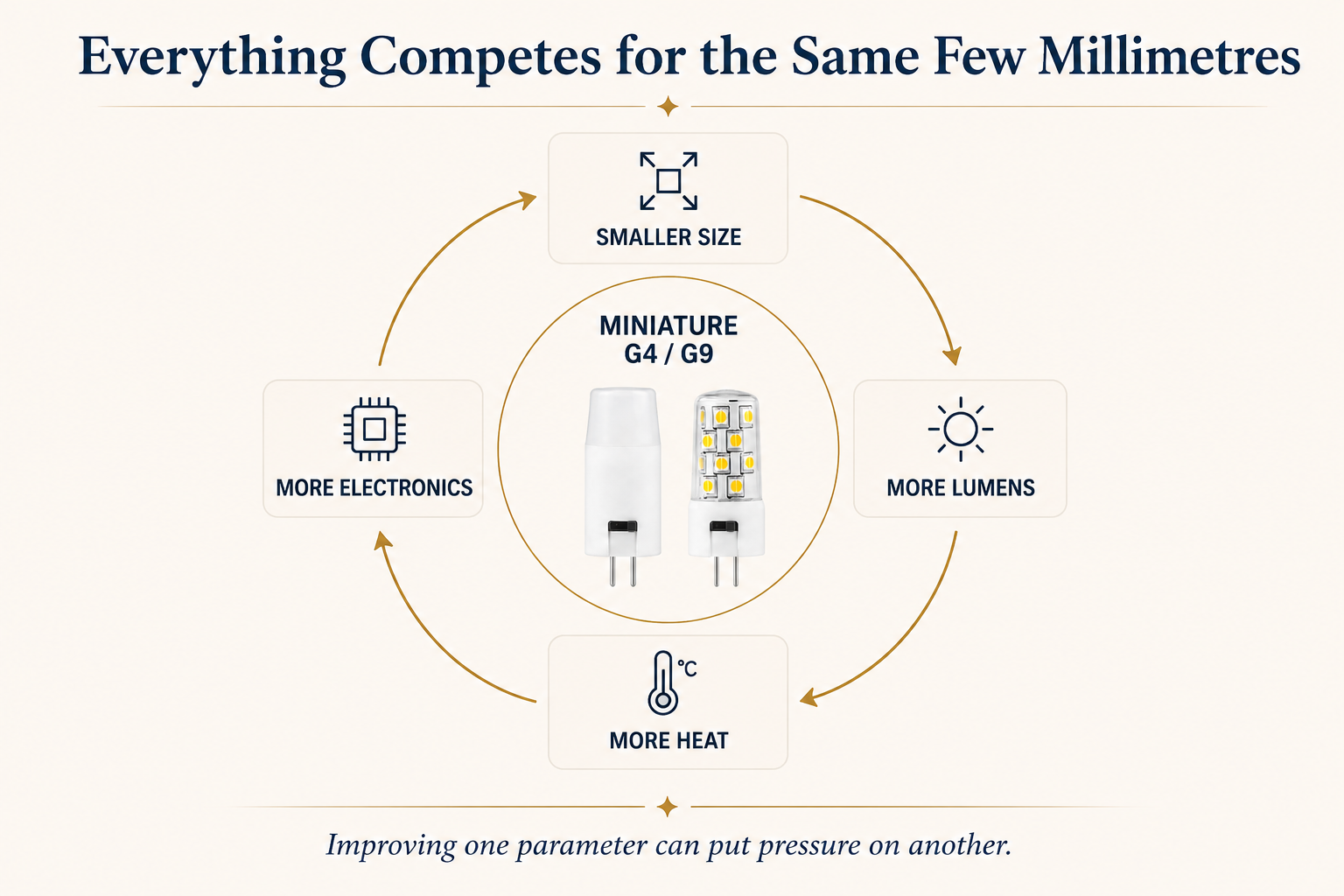
The problem is that all of these requirements compete for the same limited space.
A miniature lamp must fit LEDs, driver electronics, thermal paths, insulation and optical components into a body sometimes designed to replace a tiny halogen capsule.
And unlike a large LED bulb, there is very little room to solve problems later.
The biggest challenge in miniature LED design is not achieving one impressive specification. It is balancing all the specifications inside an extremely limited thermal and electrical space.
That trade-off is what ultimately separates a miniature LED that looks good on a datasheet from one that performs reliably inside a real luminaire.
Why Are G4 and G9 LEDs So Difficult to Design?
Start with the physical limitation.
A decorative fixture may have originally been designed around a compact halogen capsule. When converting that fixture to LED, designers usually do not want the replacement lamp to become significantly larger.
This creates an immediate engineering constraint:
Everything has to fit inside the original visual envelope.
Inside that tiny space, the manufacturer needs to accommodate:
- LED packages
- driver electronics
- PCB
- thermal management
- electrical insulation
- optical structure
- housing materials
At the same time, customers may request:
higher lumen output + CRI 90/95 + dimming + low flicker + long lifetime + compact dimensions
Each additional requirement makes the design more difficult.
Challenge #1: Heat Has Almost Nowhere to Go
Thermal management is one of the fundamental constraints in miniature LED design.
LEDs are efficient, but they still generate heat.
The driver generates heat too.
In a larger LED bulb, engineers have more surface area, more internal volume and more freedom to separate heat-sensitive components.
A miniature G4 or G9 offers far less flexibility.
Now increase the required lumen output.
More output often requires more electrical power, which generally means more heat must be managed inside essentially the same physical envelope.
This creates a chain reaction:
More Lumens
↓
Higher Power Density
↓
Higher Internal Temperature
↓
Greater Stress on LEDs and Electronics
↓
Potential Reliability Problems
This is why simply asking for the highest possible lumen output in the smallest possible G9 is not always good product engineering.
The better question is:
What lumen output can this physical platform deliver reliably under its intended operating conditions?
That distinction becomes especially important when the lamp is installed inside a small decorative enclosure where airflow is limited.
Challenge #2: Dimming Requires Electronics — Electronics Require Space
A non-dimmable miniature lamp already requires careful electrical design.
A good dimmable G9 LED adds another level of difficulty.
The driver needs to operate across different dimming conditions while remaining stable with the intended control system.
Poorly optimized combinations can produce:
- flicker
- unstable low-end dimming
- sudden drop-out
- flashing when switched off
- limited dimming range
- inconsistent behaviour between dimmers
The problem is that improving driver performance usually requires circuitry and components.
And components occupy space.
This creates one of the recurring conflicts in miniature LED development:
Mechanical engineers want the lamp smaller. Electrical engineers want more room.
Neither side is wrong.
The product only works when the two requirements are balanced.
This is also why two G9 lamps with almost identical external dimensions can behave very differently when connected to the same dimmer.
The difference is often hidden inside.
Challenge #3: High CRI Can Change the Efficiency Equation
Premium decorative lighting increasingly asks for:
CRI ≥90
or even:
CRI ≥95 with strong R9
This improves how materials, food, artwork and skin tones appear.
But high color quality is not free.
Depending on the LED platform, pushing toward higher CRI and stronger red rendering can affect luminous efficacy.
So the engineering problem becomes:
small lamp + high CRI + target lumens + acceptable power + manageable temperature
Optimizing one parameter may put pressure on another.
This is why a miniature LED specification should be evaluated as a system, rather than as independent numbers.
A customer might request:
5W / 600lm / CRI95 / tiny G9 / full-range dimming.
The right engineering response is not simply:
“Yes.”
It is:
“Can these targets coexist reliably inside this physical platform?”
That question should be answered during development — not after mass production.
Challenge #4: Dim-to-Warm Makes a Tiny Lamp Even More Complex
Now add Dim-to-Warm.
A conventional dimmable lamp primarily needs to control light output.
A Dim-to-Warm lamp must also manage the relationship between brightness and spectral output so that the light becomes warmer as it dims.
For example:
100% → 2700K
50% → approximately 2200–2400K
10% → approximately 1800K
Achieving a natural-looking transition may require multiple LED channels and more sophisticated control.
Again, all of this has to fit inside a miniature G4 or G9 body.
So when evaluating a Dim-to-Warm miniature lamp, it is not enough to check:
“Does it reach 1800K?”
The better questions are:
Is the transition smooth?
Is low-level dimming stable?
Does color quality remain acceptable throughout the curve?
Does it work with the intended dimmer?
Can it maintain acceptable thermal performance?
A specification such as 2700K–1800K describes only the endpoints.
It does not describe the quality of the journey between them.
Challenge #5: A Good Prototype Is Not the Same as Good Mass Production
This is one of the most underestimated challenges.
An engineering team can carefully tune several samples and achieve excellent results.
But a commercial order may contain:
1,000 / 5,000 / 20,000 lamps.
Now component tolerances, LED variation and production processes become important.
For multi-lamp decorative fixtures, even relatively small variations can become visible.
One lamp may be slightly warmer.
Another slightly greener.
A third may begin dimming differently.
This is why miniature LED engineering cannot stop at prototype approval.
The real challenge is not making 10 good samples. It is making thousands of lamps behave like those 10 samples.
How Do You Verify That Mass Production Matches the Design?
This is where product verification becomes as important as product design.
For applicable premium G4 and G9 programs, FRI uses 100% unit-level spectral testing of finished lamps rather than relying only on LED component specifications or limited sampling.
Each finished lamp can be measured for parameters such as:
CCT · CRI · R9 · SDCM
The workflow is:
Every Finished Lamp → Spectral Measurement → Data Verification → Outliers Removed → Consistent Shipment
This is important because the customer ultimately receives a finished lamp, not an LED chip specification.
.png)
The Real Engineering Problem: Finding the Balance
When customers develop a miniature G4 or G9, they sometimes ask:
“What is the maximum lumen output you can make?”
But maximum output is rarely the best starting point.
A more useful engineering conversation looks like this:
| Requirement | Engineering Question |
|---|---|
| Size | What physical envelope must we stay within? |
| Lumens | What output is actually required by the fixture? |
| Power | What power density can the platform manage? |
| CRI / R9 | What level of color quality is genuinely needed? |
| Dimming | Which dimmer/control system must it work with? |
| Flicker | What low-dim performance is expected? |
| Temperature | Open or enclosed luminaire? |
| Lifetime | Under what actual operating conditions? |
This changes the development philosophy from:
maximize every specification
to:
optimize the lamp for the real application.
That usually produces a better product.
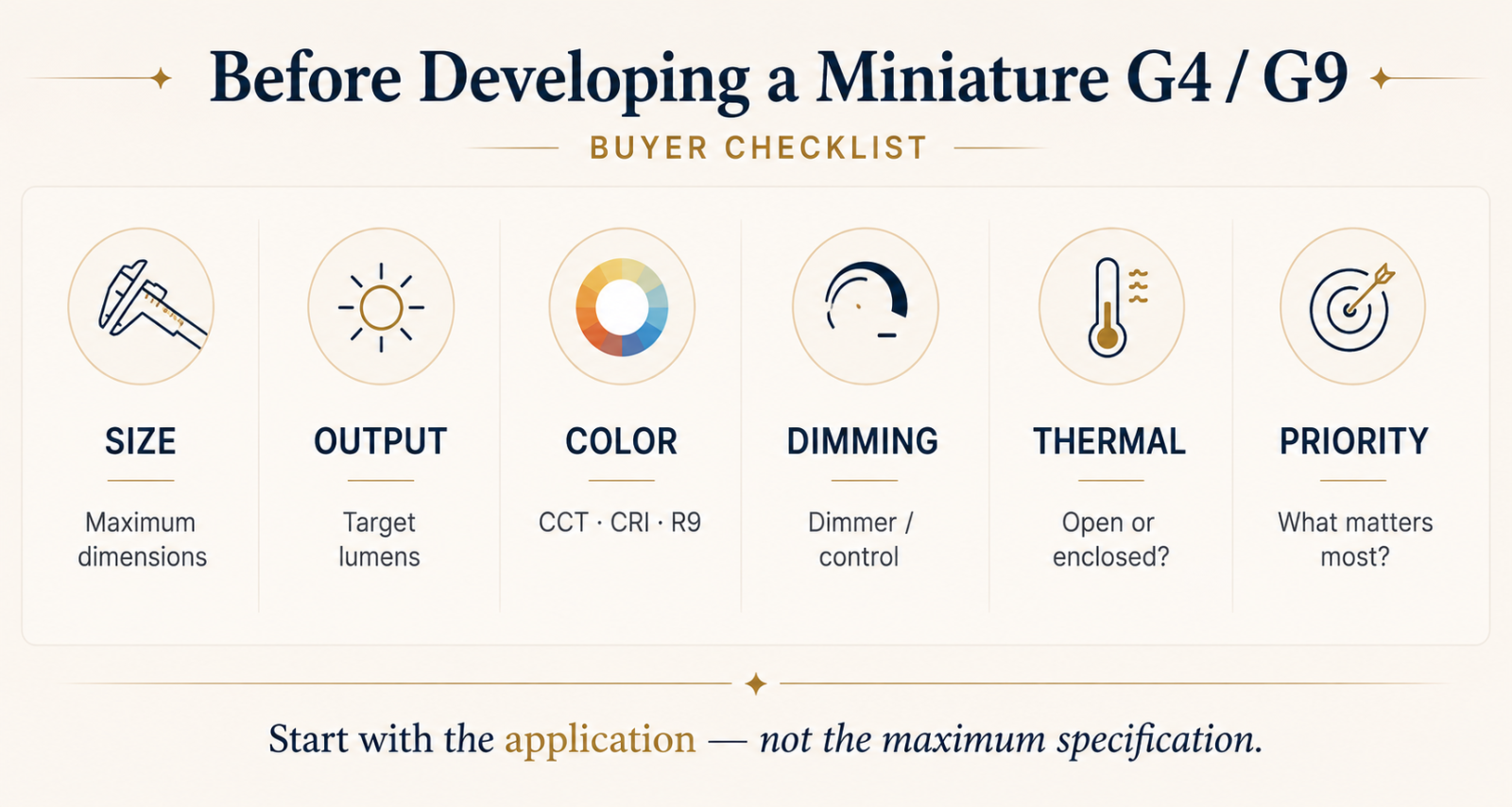
What Should Lighting Brands Define Before Developing a G4 or G9?
Before asking a supplier to develop a miniature LED lamp, define these seven things first:
1. Maximum physical dimensions
Do not provide only “G9.” Give the available diameter and length inside the fixture.
2. Target lumen output
Specify the output the application actually needs rather than automatically requesting the maximum possible.
3. Color quality
Define CRI, R9, CCT and, for premium multi-lamp fixtures, color-consistency expectations.
4. Dimming requirements
Specify whether the lamp needs TRIAC, ELV or another control method and, ideally, identify representative dimmers.
5. Lowest useful dimming level
For restaurants, hotels and decorative residential applications, low-end performance may matter more than performance at 100%.
6. Thermal environment
Tell the supplier whether the lamp operates in open air, decorative glass or an enclosed fixture.
7. Real priority
If everything cannot be maximized simultaneously, what matters most?
Size? Lumens? CRI? Dimming? Lifetime?
A good development project needs a clear priority.
What Makes a Good Miniature LED Platform?
The best miniature LED is not necessarily:
the smallest
or
the brightest
or
the highest CRI.
It is the product that delivers the right combination of:
Size + Light Output + Thermal Performance + Color Quality + Dimming + Reliability
for the intended luminaire.
That is why FRI approaches miniature G4 and G9 development as a system-level engineering problem.
Our work with miniature LED platforms focuses not only on whether a specification can be achieved in a laboratory sample, but also whether it can be reproduced and controlled during mass production.
Because the ultimate test is not the datasheet.
It is what happens after thousands of lamps are installed.
FAQ
Why is it difficult to make a high-lumen G9 LED very small?
Higher light output generally increases power density and thermal load. A miniature G9 has limited internal space and surface area for LEDs, driver electronics and heat management, so size and output must be balanced.
Why are some G9 LED lamps larger than others?
Different lumen, thermal, driver, dimming and reliability requirements can require different internal structures. Two lamps with the same G9 base may therefore have very different dimensions.
Does high CRI make miniature LED design more difficult?
It can. Higher color-rendering requirements may affect LED efficacy, meaning engineers need to balance color quality, lumen output, power and temperature.
Why do miniature G9 LEDs sometimes flicker when dimmed?
Dimming performance depends heavily on driver design and dimmer compatibility. Limited internal space makes achieving stable low-level dimming particularly challenging in miniature lamps.
Can a miniature G9 LED have Dim-to-Warm?
Yes, but Dim-to-Warm adds additional optical and electrical complexity. The CCT transition, low-dim stability, flicker, thermal performance and dimmer compatibility should all be evaluated.
How should production quality be verified?
For demanding projects, finished-product testing is more meaningful than relying only on component specifications. For applicable premium programs, FRI can use 100% unit-level spectral testing to verify finished-lamp parameters and remove outliers before shipment.
Developing a Miniature G4 or G9 LED?
If you are trying to fit more performance into a smaller decorative fixture, start with the application rather than a long list of maximum specifications.
Send us:
Maximum lamp dimensions
Target lumens
Voltage
CCT / CRI / R9
Dimming requirement
Fixture environment
Reference halogen or existing LED
We can evaluate where the real engineering limits are and which existing miniature LED platform is the better starting point.
The goal is not to make every specification bigger.
The goal is to make the entire lamp better.