
How Lighting Designers Use Dim-to-Warm in Hotels and Restaurants
Author:Admin Publish time: August 14, 2026 Origin: Site
Great hospitality lighting does more than illuminate a space. It changes how the space feels as the evening unfolds.
Walk into a hotel lobby at 10 a.m. and return at 10 p.m. The architecture has not changed. The furniture has not changed. Yet a well-designed space can feel completely different.
One of the reasons is light.
In hospitality environments, lighting designers increasingly think beyond simple brightness control. Instead of asking only “How much light do we need?”, they also consider:
“What should this space feel like at this time of day?”
This is where Dim-to-Warm lighting becomes particularly useful.
Unlike standard LED dimming, which reduces brightness while keeping roughly the same colour temperature, Dim-to-Warm LEDs become progressively warmer as they dim — creating a transition closer to the familiar behaviour of incandescent and halogen light sources.
For hotels, restaurants, bars and other atmosphere-driven spaces, that difference can be significant.
What Is Dim-to-Warm Lighting?
A standard 2700K LED generally remains around 2700K whether operated at full output or dimmed to a low level.
The room becomes darker, but the character of the light remains relatively similar.
Dim-to-Warm works differently.
A typical Dim-to-Warm lamp might transition from:
2700K at higher output
↓
2400K
↓
2200K
↓
1800K at low dimming levels
The exact curve depends on the lamp design.
The important point is that brightness and colour temperature change together.
This recreates an important characteristic of traditional incandescent and halogen lighting: as the source dims, the light becomes warmer.
For hospitality designers, this provides another layer of atmosphere control without necessarily requiring the guest or restaurant staff to manually select different colour temperatures.
Why Dim-to-Warm Works So Well in Hospitality
Hotels and restaurants rarely operate with one visual atmosphere throughout the day.
Consider a hotel restaurant.
Breakfast
The space may need to feel:
fresh → bright → comfortable → energetic
Dinner
The same space may need to feel:
warm → intimate → relaxed → sophisticated
Late Evening
The desired atmosphere may shift further toward:
low light → warmer tones → visual intimacy
A conventional dimmable LED can reduce the illumination level.
But reducing illumination alone does not always create the desired emotional transition.
Brightness controls visibility. Colour temperature helps shape atmosphere.
Dim-to-Warm allows both to change together.
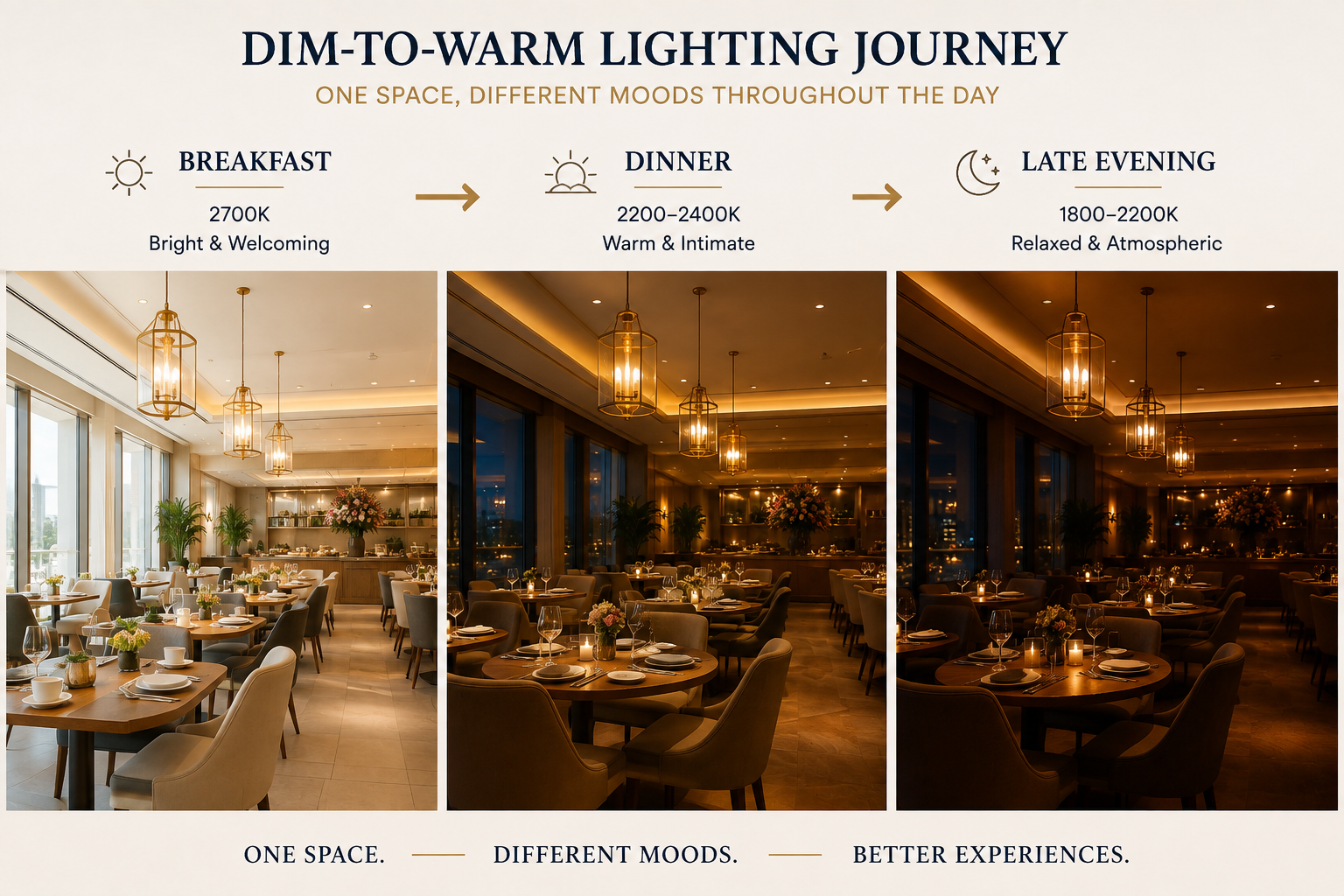
One space. Different moods throughout the day.
1. Restaurants: Creating a More Intimate Dinner Atmosphere
Restaurants are one of the clearest applications for Dim-to-Warm.
During preparation, cleaning or daytime service, higher light levels may be useful.
As dinner begins, the lighting can gradually be reduced.
With standard dimming:
2700K → 2700K → 2700K
Only the brightness changes.
With Dim-to-Warm:
2700K → 2400K → 2200K → 1800K
The visual environment becomes both darker and warmer.
Warm light can be particularly effective around materials commonly found in premium restaurants:
- timber
- brass
- bronze
- natural stone
- warm fabrics
- decorative glass
It can also change the perceived character of table settings and surrounding finishes.
This is why the quality of a restaurant's nighttime lighting cannot be judged only by lumen output.
2. Hotel Lobbies: Changing the Mood Without Changing the Interior
Hotel lobbies present another interesting challenge.
They operate almost continuously, but their function changes throughout the day.
In the morning, the lobby may need enough light for:
check-out → luggage → meetings → circulation
In the evening, the same lobby may become part of the guest's leisure experience.
Decorative chandeliers, wall lights and table lamps can then take a more prominent role.
Instead of switching between visually unrelated lighting scenes, Dim-to-Warm can help produce a smoother transition.
A chandelier using Dim-to-Warm G9 LED lamps, for example, can provide useful illumination at higher output and then become warmer as the scene is dimmed later in the evening.
The luminaire remains the same.
The emotional character changes.
3. Hotel Guest Rooms: Giving Guests Simpler Atmosphere Control
Guest rooms are different from public spaces because the person controlling the light is usually not a lighting professional.
The controls therefore need to be intuitive.
Guests understand:
brighter and darker.
They may not want to choose between:
2700K / 2400K / 2200K / 1800K.
Dim-to-Warm can make the colour transition happen naturally through the dimming action itself.
Higher output can support activities such as unpacking or getting ready.
At lower levels, warmer light can create a softer environment beside the bed or seating area.
For designers, this means a relatively familiar control experience can produce a more sophisticated lighting result.
4. Bars and Lounges: Where Low-Dim Performance Really Matters
Bars and lounges often operate much closer to the bottom of the dimming range than ordinary residential spaces.
That exposes one of the most important differences between LED lamps.
A lamp can look perfectly acceptable at 100% output and perform poorly at 10–20%.
Possible problems include:
- visible flicker
- unstable low-end output
- sudden drop-out
- inconsistent dimming between lamps
- lamps switching off at different points
- colour differences between adjacent lamps
In a decorative installation containing 20, 50 or even 100 miniature lamps, these differences become much easier to notice.
So for hospitality projects, specifying Dim-to-Warm is only part of the job.
The designer also needs to consider:
How does the lamp actually behave at the dimming levels where guests will experience it?
Why G4 and G9 Matter in Decorative Hospitality Lighting
In many decorative luminaires, the light source itself must remain physically small.
This is where G4 and G9 LED lamps become particularly relevant.
They are commonly considered for compact decorative applications such as:
- chandeliers
- wall sconces
- glass pendants
- bedside luminaires
- decorative table lamps
- compact accent fixtures
But replacing a traditional miniature halogen source with LED involves more than matching the base.
The designer may also need to consider:
physical size + lumen output + CRI + colour temperature + dimming curve + flicker + driver/dimmer compatibility
This becomes especially important when the light source is visible through decorative glass.
A beautiful luminaire can lose much of its intended nighttime character if the replacement LED is too cool, dims poorly or produces inconsistent light between lamps.
Dim-to-Warm Is Only as Good as Its Colour Quality
Warm colour temperature alone does not guarantee beautiful light.
Imagine dimming a restaurant from 2700K to 1800K.
The colour temperature becomes warmer — but if colour rendering is poor, food, timber, fabrics and skin tones may still look flat or unnatural.
That is why hospitality Dim-to-Warm specifications should also consider:
CRI
Higher colour rendering helps materials and interior finishes appear more natural.
R9
Strong red rendering is particularly relevant where warm materials, food and skin tones are important.
Colour Consistency
In chandeliers or multi-lamp installations, visible colour differences between adjacent lamps can quickly reduce the perceived quality of the installation.
Flicker
A warm atmosphere is not very premium if low-level dimming introduces visible instability.
In practice, these characteristics should be evaluated together, rather than treating Dim-to-Warm as an isolated specification.
What Should Lighting Designers Check Before Specifying Dim-to-Warm?
For a hotel or restaurant project, a useful starting checklist is:
| Check | Why It Matters |
|---|---|
| Dimming Range | Determines how low the scene can comfortably go |
| Warmest CCT | Defines the low-light atmosphere |
| Dimming Curve | Determines whether the transition feels natural |
| CRI / R9 | Influences food, materials and skin tones |
| Colour Consistency | Important for multi-lamp decorative fixtures |
| Flicker Performance | Especially important at low dim levels |
| Dimmer Compatibility | Lamp and control system must work together |
| Physical Size | Critical for compact G4/G9 luminaires |
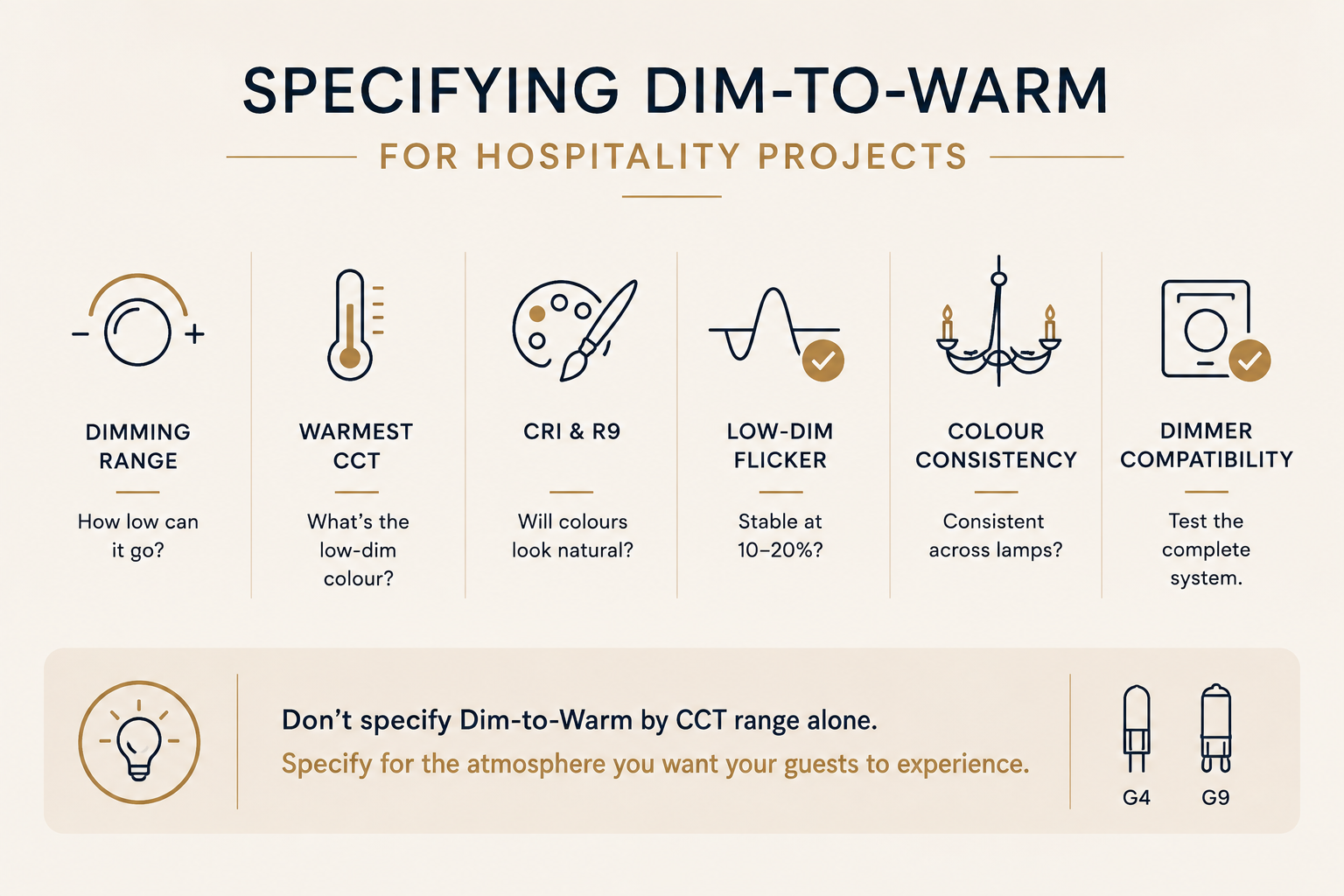
How FRI Approaches Dim-to-Warm G4 & G9
For miniature decorative lighting, fitting all of this performance into a small lamp is one of the engineering challenges.
FRI develops G4 and G9 miniature LED platforms with options including Dim-to-Warm, high colour rendering and dimming performance designed for decorative applications.
Our approach is to evaluate more than the headline CCT range.
Depending on the product platform and project requirement, we look at factors including:
colour quality → colour consistency → dimming behaviour → low-dim stability → flicker performance → dimmer compatibility → physical size
Because the final objective is not simply to make a lamp that changes from one CCT to another.
It is to make the lighting experience feel right inside the luminaire and the space.
A good Dim-to-Warm lamp should not call attention to the technology. The guest should simply notice that the room feels better.
FAQ
What is Dim-to-Warm lighting?
Dim-to-Warm lighting reduces both brightness and colour temperature as the lamp is dimmed, producing progressively warmer light at lower output levels.
Why is Dim-to-Warm useful in restaurants?
It allows a restaurant to move from brighter functional lighting to a warmer, more intimate evening atmosphere using the dimming process itself.
Is Dim-to-Warm the same as tunable white?
No. Tunable-white systems generally allow colour temperature to be controlled independently. Dim-to-Warm links the warmer colour transition to decreasing light output.
What colour temperature is best for restaurant lighting?
There is no single ideal value. Many hospitality environments use warm white lighting, while Dim-to-Warm can allow the atmosphere to move from around 2700K toward approximately 2200K or 1800K at lower dimming levels, depending on the product and design intent.
Can G9 LEDs be Dim-to-Warm?
Yes. Dim-to-Warm G9 LED lamps are available, but designers should evaluate the actual CCT transition, colour rendering, low-dim behaviour and dimmer compatibility rather than relying only on the “Dim-to-Warm” label.
What should I test before specifying a Dim-to-Warm G9?
Test the lamp in the actual or representative luminaire and dimming system wherever possible. Pay particular attention to low-level stability, flicker, colour consistency, minimum dimming level and the smoothness of the warm transition.
Designing a Hotel or Restaurant Around Dim-to-Warm?
If you are developing a chandelier, pendant, wall light or other decorative fixture using G4 or G9 LEDs, send us the basic project requirements:
Lamp base + available dimensions + target lumens + CCT range + CRI requirement + dimmer/control system
We can help evaluate which miniature Dim-to-Warm platform is the better starting point for the application.
Send Us Your G4/G9 Dim-to-Warm Requirement →
The goal is not simply to make the room darker.
It is to make the atmosphere warmer as the evening unfolds.