DUV: A Technical Framework for Defining Premium LED Light Quality
Author:Admin Publish time: March 23, 2026 Origin: Site
Why DUV Alone Is Not Enough — And What High-End Lighting Really Requires
In today’s LED market, most specifications focus on:
- CCT (2700K / 3000K)
- CRI (80 / 90 / 95)
- Lumen output
But in real projects — especially high-end applications — these are not enough to guarantee visual quality.
To truly define premium lighting, we need to look deeper.
This starts with one critical parameter:
DUV
1. What DUV Really Controls (And Why It Matters More Than You Think)
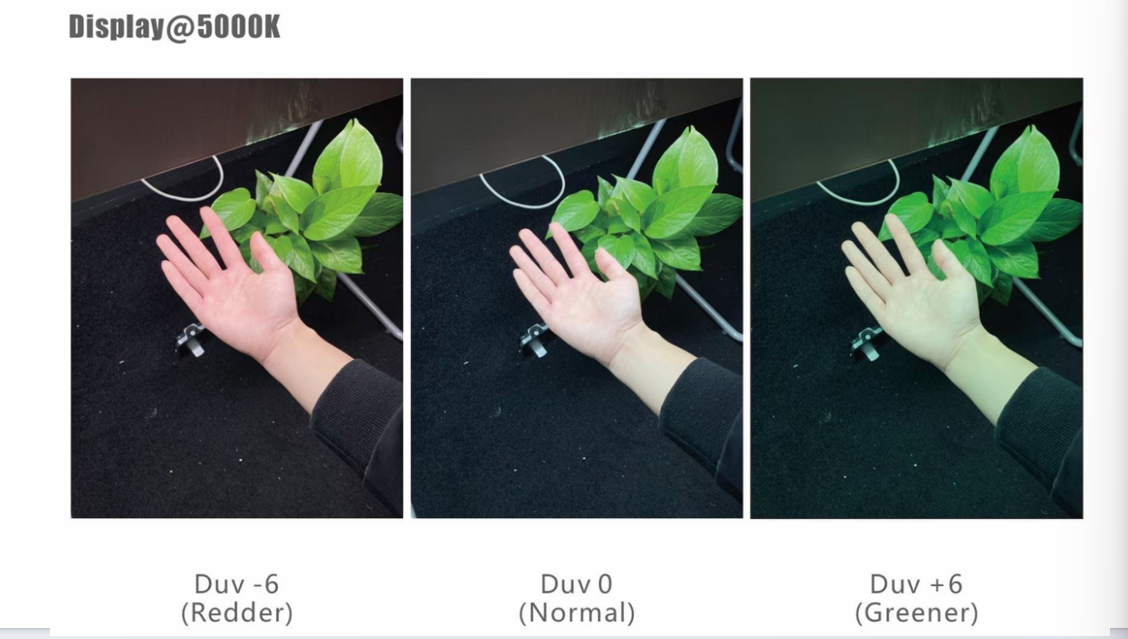
DUV defines how far a light source deviates from the ideal white (Planckian locus):
- DUV > 0 → green shift
- DUV < 0 → pink shift
- DUV ≈ 0 → neutral white
Two light sources can have:
Same CCT (e.g., 3000K)
Same CRI
But still look completely different due to DUV differences
This is why many lighting issues are not specification failures — but perception failures.
2. The Hidden Problem: Standard Compliance ≠ Visual Quality
Most industry standards (e.g., ANSI C78.377) allow:
DUV tolerance: ±0.006
This defines a “valid white light range”.
However:
- This range is designed for classification, not premium quality
- Within this range, visible tint differences still occur
- Especially in multi-light environments
Even within ±0.006:
Lights can appear greenish or inconsistent to the human eye
Real implication:
Passing certification does NOT guarantee visual consistency
This is one of the most misunderstood gaps in the industry.
3. When DUV Becomes Visible (Real Application Risks)
DUV deviations become critical in:
• Multi-light installations
(chandeliers, retail, hospitality)
→ slight differences = visible mismatch
• White or neutral environments
(walls, ceilings, galleries)
→ tint differences amplified
• Human-centric spaces
(hospitality, residential, retail)
→ green shift reduces perceived quality
In practice:
Even DUV ≈ 0.003 can be noticeable
4. What Defines a Premium DUV Level?
Based on high-end applications:
|
Level |
DUV Range |
Visual Result |
|
Standard (compliant) |
±0.006 |
Acceptable, but risk of visible tint |
|
High quality |
±0.003 |
Generally consistent |
|
Premium |
≤ ±0.002 |
Visually clean |
|
Color-critical |
≤ ±0.001 |
Near perfect |
5. Why DUV Alone Is Still Not Enough
Here is where most discussions stop — but they shouldn’t.
Because:
DUV controls tint — not color quality
A light can have perfect DUV but still look poor.
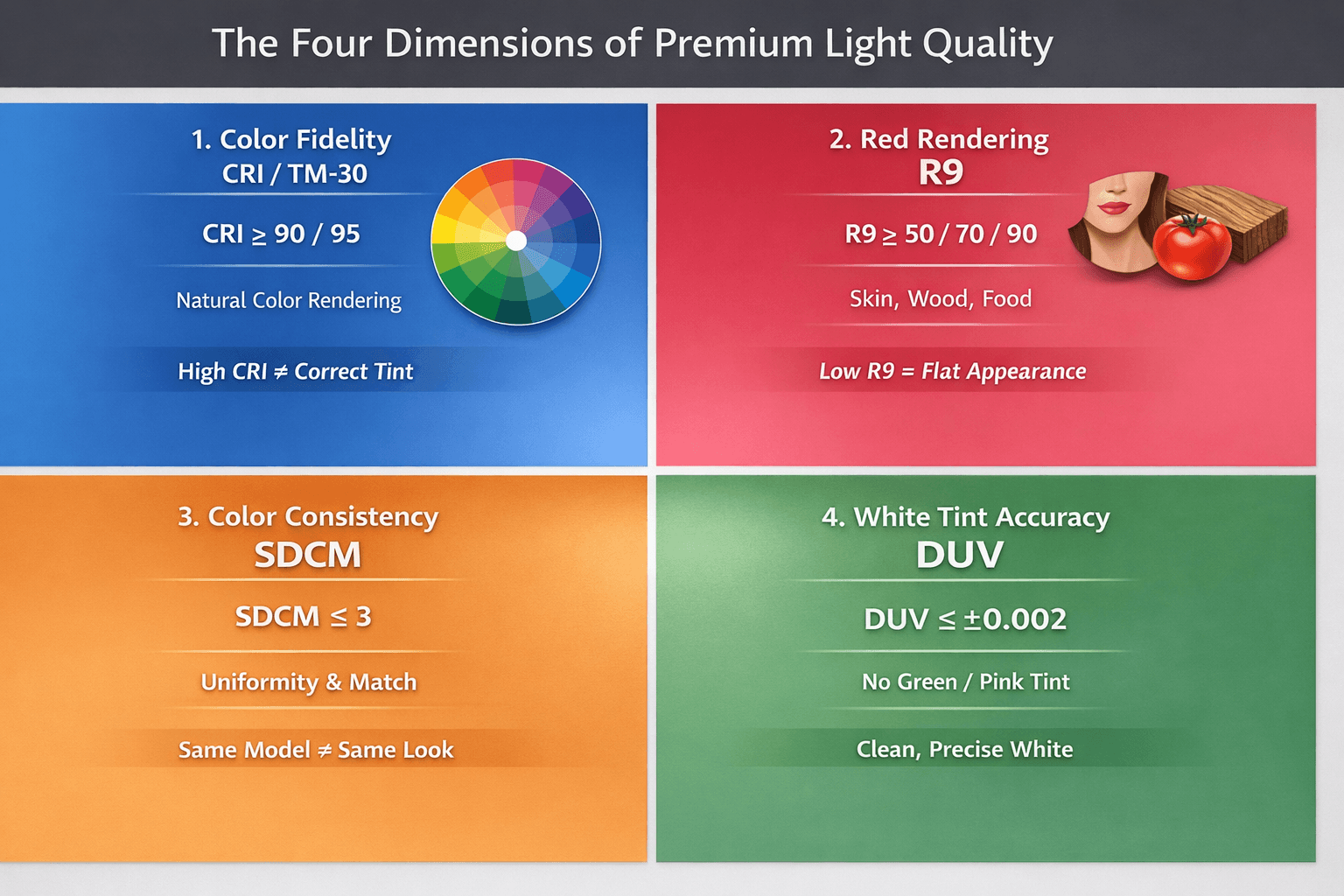
To define true premium lighting, you need a multi-dimensional framework:
7. A Simple Truth the Market Often Misses
Most suppliers optimize:
Cost
Efficiency
Basic compliance
But high-end lighting requires:
Control across ALL 4 dimensions
Not just one.
8. Our Approach: Engineering Light Quality — Not Just Meeting Specs
A controlled system — not a coincidence
Our baseline:
- DUV ≤ ±0.002
- CRI up to 95
- R9 ≥ 50 / 70+
- SDCM ≤ 3 (tight binning)
- 100% testing (not sampling)
Why this matters:
We don’t just ensure compliance.
We ensure:
- Visual consistency
- Application reliability
- Perceived quality
9. What This Means for Lighting Brands & Designers
If you are targeting:
- Premium residential
- Hospitality
- Retail
- Architectural lighting
Then your product definition should evolve from:
“Is it within spec?”
To:
“Does it look right in real space?”
10. Final Perspective
Call to Action
If you're evaluating LED sources for high-end applications:
We can support you with:
- DUV-controlled samples (≤ ±0.002)
- Side-by-side visual comparison
- Application-based tuning (neutral / slight negative DUV)
- Full data transparency
Because premium light is not defined by one parameter.
It is defined by how everything works together.