Australia MEPS for G4 & G9 LED Lamps: What Lighting Brands Need to Know in 2026
Author:Admin Publish time: August 12, 2026 Origin: Site
Before placing your next G4 or G9 LED order, make sure the product is ready for Australia — not just ready for production.
If you sell or import G4, G9 or other replacement LED lamps into Australia, MEPS and GEMS compliance now needs to be considered much earlier in product development.
The Greenhouse and Energy Minimum Standards (LED Lamps) Determination 2025 came into effect on 3 March 2026. LED lamps that fall within scope must meet the applicable MEPS and other requirements and be registered under GEMS before they can legally be supplied in Australia, unless relevant grandfathering provisions apply.
For a lighting brand, the question is no longer simply:
“Does this G9 have the right lumen output, CRI and dimming performance?”
It is also:
“Is this exact G4 or G9 model ready for the Australian market?”
Here is what we recommend checking before placing your next PO.
5 Things to Check Before Ordering G4 or G9 LEDs for Australia
Before production, confirm:
1. Is the exact G4 or G9 model within the applicable regulatory scope?
2. Has the final technical specification been fixed before testing?
3. Is an appropriate test report available for the model?
4. Do the tested product, model number, technical data and packaging match?
5. Who will manage the GEMS registration?
This is more useful than simply asking your supplier:
“Do you have MEPS?”
Because MEPS is not simply a certificate.
For an Australian LED lamp project, the practical process is:
Product → Scope Check → Testing → Documentation → GEMS Registration → Packaging → Market
The Australian regulator confirms that in-scope LED lamps must meet MEPS and other requirements, carry mandatory packaging information and be registered.
Does a G9 LED Need MEPS in Australia?
This is one of the first questions a lighting brand should ask when sourcing a G9 LED for the Australian market.
The answer should not be determined by the lamp base alone.
A product being called a “G9 LED” or “G4 LED” does not automatically tell you whether that specific model falls within the Determination. The exact product needs to be checked against the applicable scope and exclusions.
If the model is in scope, it needs to meet the applicable requirements and be registered before supply in Australia.
This distinction matters because a decorative lighting range may include:
- G4 LED replacement lamps
- G9 LED replacement lamps
- 12V miniature LEDs
- mains-voltage lamps
- dimmable lamps
- Dim-to-Warm lamps
- LED modules
- complete luminaires
Do not assume they all follow exactly the same compliance route.
Check the exact product first.
Why G4 and G9 Projects Need Extra Attention
Miniature LED ranges often contain many versions built around what appears to be the same platform.
For example, one G9 range may include:
- 2700K / 3000K
- CRI90 / CRI95
- different wattages
- different lumen outputs
- standard dimming
- Dim-to-Warm
Commercially, they may all look like “the same G9.”
Technically, they may not be.
Changes to the LEDs, driver, power or electrical configuration can create a different technical product even when the housing looks identical.
That is why we prefer this workflow:
Define G4/G9 Range → Check Australian Requirements → Plan Testing → Confirm Models → Production
Where models meet the relevant family requirements, Australia allows a standard family registration containing up to 100 similar models. But simply using the same housing does not automatically make several G9 lamps one compliant family.
Planning the range before testing can therefore save unnecessary work later.
What Does MEPS Testing Actually Check?
MEPS testing is not simply a wattage check.
Depending on the product and applicable requirements, the LED Lamps Determination covers performance characteristics including areas such as luminous efficacy, CRI, standby power where applicable, beam angle for directional lamps, lumen maintenance and survival factors. The official guidance also identifies accepted test methods for relevant performance characteristics.
For a lighting brand, however, the most important principle is simpler:
The performance declared for your G4 or G9 should be supported by the product that was actually tested.
And the testing process needs to be planned early: the official guidance notes that the combined luminous-flux-maintenance and endurance test can involve a 3,600-hour supply-switching test.
This is another reason not to leave Australian compliance until the PO is already in production.
FRI Has Already Completed MEPS Testing
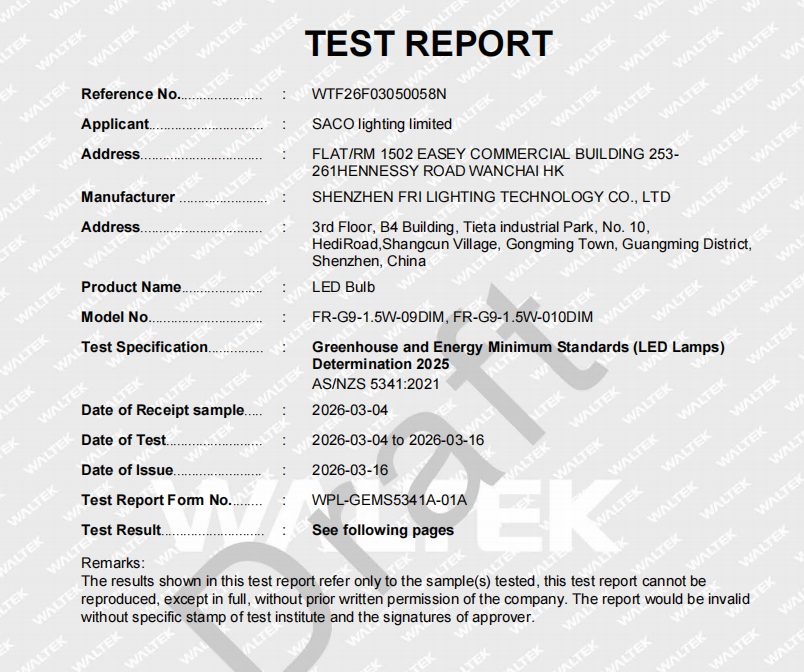
For Australian miniature LED projects, FRI is not starting from zero.
We have already completed MEPS-related testing for applicable LED lamp models and have supporting test reports available.
This means we already have practical experience with:
- MEPS test preparation
- LED lamp performance data
- technical documentation
- model identification
- coordinating tested specifications with production
For customers developing G4 or G9 LED lamps for Australia, a new project may therefore be able to start from an existing tested platform, depending on the exact specification.
This does not mean every G4 or G9 model is automatically covered by an existing report.
The exact model still needs to be checked.
But there is a meaningful difference between starting with a supplier that has already been through the testing process and starting from zero.
Passing the test is important. Keeping the production lamp aligned with the tested lamp is even more important.
The Tested G9 Must Match the Production G9
G9 Sample Tested
↓
Customer Requests More Lumens
↓
Power Increased
↓
Driver Modified
↓
Mass Production
Externally, the lamp may still look exactly the same.
Technically, it has changed.
Australia requires a test report for each LED lamp model registered, and the lamp must be tested under the conditions specified in the Determination. For a standard family application, the least-efficient model's test report must be submitted, while reports for the other registered models still need to exist and be available if requested.
That is why every engineering change should trigger one question:
“Does this change affect our existing test or registration basis?”
A reliable G4/G9 supplier therefore needs to do more than provide a report.
They need to control the relationship between:
Test Sample → Technical Documentation → Registered Model → Mass Production
Before You Place Your Australian G4/G9 PO
The real question is not:
“Can you make a G9 LED?”
It is:
“Can you manufacture the same G9 that was tested and documented?”
That is a much better way to evaluate a supplier.
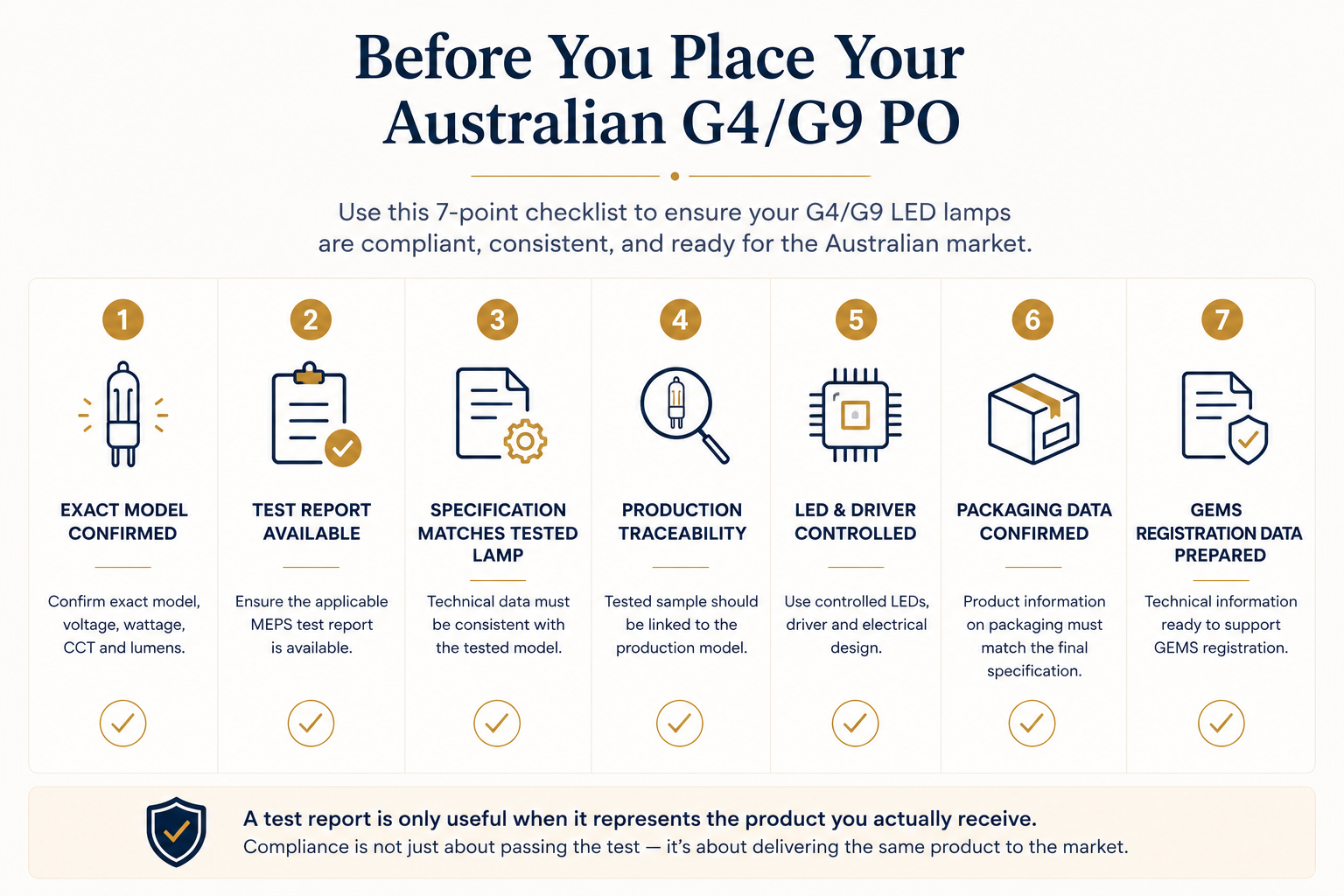
BEFORE YOU PLACE YOUR AUSTRALIAN G4/G9 PO
✓ Exact Model Confirmed
✓ Test Report Available
✓ Specification Matches Tested Lamp
✓ Production Traceability
✓ LED & Driver Controlled
✓ Packaging Data Confirmed
✓ GEMS Registration Data Prepared
Don't Leave Packaging Until the End
For private-label G4 and G9 LED projects, packaging is another area that should be checked before mass production.
The 2025 Determination includes mandatory packaging information requirements for in-scope LED lamps.
So the better workflow is:
Final Specification → Testing → Registration Information → Packaging Review → Mass Printing
Product information on the packaging should remain consistent with the final lamp and supporting documentation.
Finding a mismatch before printing thousands of boxes is much easier than fixing it afterwards.
How FRI Supports Australian G4 & G9 Projects
For Australian projects, FRI focuses on the product side of compliance.
Our preferred process is:
G4/G9 Specification
→ Existing MEPS-Tested Platform
→ Sample & Testing
→ Technical Documentation
→ GEMS Registration Support Data
→ Packaging Check
→ Controlled Mass Production
Our objective is not simply to supply a lamp described as “MEPS ready.”
It is to keep the:
tested product
documented product
and
mass-production product
aligned.
For lighting brands sourcing G4, G9, CRI90/95, dimmable or Dim-to-Warm miniature LED lamps, that consistency can be just as important as passing the initial test.
FAQ
Does a G9 LED need MEPS/GEMS registration in Australia?
If the specific G9 model falls within the scope of the LED Lamps Determination 2025, it must meet the applicable requirements and be registered. The G9 base alone is not enough to determine regulatory status.
Does a G4 LED need MEPS in Australia?
The same principle applies to G4 LEDs. The exact product should be assessed against the scope and exclusions of the Determination.
Has FRI already completed MEPS testing?
Yes. FRI has completed MEPS-related testing for applicable LED lamp models and has supporting test reports available. Whether a particular G4/G9 specification can use an existing tested platform needs to be confirmed model by model.
Does every registered LED lamp model need a test report?
Yes. The GEMS Regulator states that a test report must exist for every LED lamp model registered and be available upon request.
Can multiple G4 or G9 models be registered as one family?
Potentially. A standard family can contain up to 100 models that satisfy the relevant family requirements. Similar appearance or the same G9 housing alone does not establish eligibility.
Does having a MEPS test report mean the process is complete?
No. Testing is one part of the process. In-scope products also need to satisfy the applicable registration, product-information and other requirements before supply.
Not Sure Whether Your G4/G9 Is Ready for Australia?
If you already have a G4/G9 specification, model list, existing test report or packaging artwork, send it to us before mass production.
Because FRI already has MEPS testing experience and supporting reports for applicable LED lamp models, we can first check whether your target product may build from an existing tested platform and what product-side information still needs to be prepared.
Send Us Your G4/G9 Specification →
Start before testing. Check before packaging. Confirm before production.
Official Australian Resources
For the latest regulatory information, refer directly to the Australian Government's LED Lamps — Energy Rating, LED Lamps Determination 2025 guidance and LED Lamp Registration Guide.